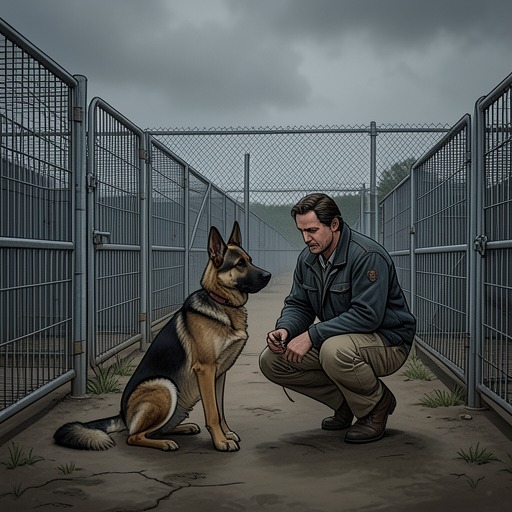
Darnell Hackworth
World War ZDarnell Hackworth is a former military dog handler and the soft-spoken co-manager, with his wife, of the last surviving retirement farm for the army’s four-legged veterans. His account gives the K-9 Corps a history more complicated than its popular legends: dogs detected infection, guided firing lines, entered urban ruins, guarded long-range missions, and sometimes became casualties of the same institutional logic that made them effective. Hackworth’s own story makes that history personal. His devotion to dogs begins not with sentiment but with violence, hunger, and the discovery that protecting a vulnerable animal can restore a damaged human being to purpose.
Identity and Background
Hackworth appears in Ainsworth, Nebraska, where he and his wife run a retirement farm for military dogs. Farms of this kind once existed across nearly every state, but this is the only one left. The setting turns him into both caretaker and archivist: he is preserving living veterans while explaining a military system that has largely vanished from public memory. His shyness and quiet manner contrast with the severity of what he describes, and his recollections repeatedly move between technical instruction, battlefield horror, and understated grief.
He rejects the simplified cultural memory represented by the children’s story “Dax.” That book celebrates a Dalmatian who helps an orphan reach safety, but Hackworth insists that the dog was not military and that rescuing lost children represented only a small portion of the dogs’ contribution. His correction is not merely professional defensiveness. It restores scale to an erased labor force, replacing a sentimental individual story with an account of thousands of animals trained for detection, combat support, reconnaissance, and protection.
The K-9 Corps and Its Methods
The first major wartime use of dogs was triage. Following the Israeli practice, personnel were sent past dogs kept in cages so the animals could identify infection by scent. The cages were necessary because early-war dogs could attack the person being tested, one another, or their own handlers. Hackworth does not condemn this terror response; he explains that it was an involuntary instinct, intensified by breeding, and that the same instinct probably saved millions of lives. The program exploited fear, but it also depended on the dogs’ unusual sensitivity to the changed human environment.
The American approach attempted to incorporate that instinct into disciplined training rather than merely provoke it. Puppies had to be selected young because even prewar veterans were “hardwired berserkers,” while pups born after the crisis seemed to have encountered the smell of death from birth. In the induction test, puppies were separated from Zack by wire mesh. Some, designated Bs, whimpered or howled and lost control; the promising As held Zack’s gaze, bared their teeth, and maintained enough composure to become trainable. Self-control was therefore the foundation, but not the finished product.
Training remained brutally demanding. Dogs had to endure physical training, obey commands, and demonstrate the intelligence and discipline required of soldiers. The washout rate reached 60 percent, and recruits could be badly injured or killed. Handlers underwent the same basic training and then ten additional weeks of advanced individual training, including Live Enemy Exercises. Hackworth emphasizes that the handlers were not merely supervising animals from a safe distance: the partnership was tested from its first day, and the dog’s survival depended on the handler’s capacity to work within the animal’s instincts without surrendering control.
The dogs’ missions turned that partnership into battlefield tactics. In Lure operations, one dog searched for Zack and drew the living dead toward a firing line. Early teams rushed in, barked, and fled, but later dogs learned to remain only a few feet ahead of the targets, retreating slowly so that they could herd the maximum number into the kill zone. Decoy missions shifted the point of contact to the far side of an infested area, delaying the approach and opening the way for the Lemming tactic. During the Denver push, a dog climbed to the roof of a building across from an infested tower and barked until the reanimated victims climbed after it and fell from the roof. Afterward, Lemming entered the formal playbook, and infantry units used it even when no K-9 team was available.
Urban warfare required another form of specialization. Hackworth describes Hound Town, the K-9 Urban Warfare School established in Mitchell, Oregon, a sealed abandoned town still filled with active Gs. Small terriers were valuable there because they could move through rubble and narrow choke points. Hackworth worked with a dachshund, whose compact body and original breeding as a “badger dog” made it suited to ducts, crawl spaces, air shafts, and gaps between walls. The program’s preference for mixed-breed dogs also reflected practical priorities: purebreds were considered too neurotic and medically fragile, whereas the new generation was selected for physical constitution and mental stability.
Risk, Loss, and the Handler’s Bond
Long-range patrols over wild terrain exposed teams to more than Zack. Feral K-9 packs, formed from pets and strays that had degenerated into hunting groups, threatened missions moving through low-infestation zones. Many early patrols were aborted before escort dogs were deployed. Hackworth recalls two escorts assigned to his dog, Pongo, a pit bull and Rottweiler mix, and Perdy, a huge shepherd hybrid. Their handlers’ prior training made the arrangement possible, and the escorts drove off feral packs fourteen times, engaging directly twice. On one occasion, Hackworth heard Perdy’s jaws crack the skull of a two-hundred-pound mastiff through the harness surveillance microphone.
The program’s violence also produced an institutional crisis. Hackworth describes the proposed “Fragmuts” project, inspired by the Russian use of explosive-laden mine dogs during World War II. The plan nearly received approval, but the situation was no longer desperate enough to justify it. He believes the decisive restraint came from fear of another Eckhart incident. Sergeant Eckhart’s partner fell into a ditch and broke his leg during a Lure mission near Little Rock. When an officer prevented her from going after him by invoking regulations, she shot the officer, was arrested, and was later hanged in a highly public execution while she listened to the dead surround her partner.
Eckhart’s execution reaffirmed discipline and the rule of law, but it also forced the army to change its treatment of handlers. They were allowed to pursue partners in danger even at risk to themselves, and the army began treating dog and handler as a team rather than regarding the animal as replaceable equipment. The change was driven partly by statistics: handlers had the highest suicide rate of any service branch, exceeding even Special Forces and Graves Registration. Hackworth says that handlers from thirteen other countries reported the same emotional reality. Their extraordinary attachment made them effective, but losing a partner could destroy the person who had formed it.
The Road to Maze
Hackworth’s own induction into this world began after he escaped his apartment in Atlanta and spent three months running, hiding, and scavenging. By the time he reached a deserted road in the Colorado Rockies, he was suffering from rickets and fever and weighed only ninety-six pounds. Beneath a tree, he found two men beside a fire and a small mutt whose paws and snout had been tied with shoelaces. The dog’s face was caked with dried blood, and it lay glassy-eyed and whimpering.
Hackworth barely remembers what followed. A bat was found broken over one attacker’s shoulder, and Guardsmen discovered Hackworth pounding the other man’s face. Even while cuffed to a car wreck and struck to regain his attention, he kept repeating that no one should hurt the dog. The men called him crazy, but the lieutenant recognized something else in the scene: Hackworth’s willingness to risk himself for an animal marked the instinct required of a handler. His military identity therefore emerged from an act of protection before it emerged from formal training.
The dog did not receive the heroic future Hackworth might have wished for. The men had struck it with a rock, damaging its ear canals so that it became deaf in one ear and partially deaf in the other. Its nose remained functional, however, and after Hackworth found it a home, it became an effective ratter, hunting enough vermin to help feed the family through the winter. The modest outcome matters because Hackworth refuses to convert suffering into a perfect rescue narrative. He calls it a kind of happy ending, but one marked by permanent injury, practical usefulness, and survival rather than triumph.
The episode also exposes the depth of his transformation. Before it, Hackworth says he hated dogs as dirty, smelly, slobbering nuisances and refused to touch them. His later life is built around the very creatures he once despised. The change is not presented as a sudden sentimental revelation; it grows from a bodily response to cruelty, then becomes a professional bond, and finally settles into lifelong care for retired animals.
Narrative Role and Significance
Hackworth’s testimony expands the meaning of military cooperation beyond human institutions. Dogs are not passive equipment in his account. They smell infection, read danger, choose tactical positions, herd targets, protect patrols, and respond to the living dead through instincts humans cannot share. Yet their agency is always entangled with human training and command structures, creating a tension between treating them as soldiers and treating them as expendable assets.
His account also complicates the moral boundary between civilization and ferality. The army trains controlled aggression in dogs while fighting feral packs that have lost domestication; it uses animal fear as a diagnostic tool, then teaches selected animals to regulate that fear; it relies on handlers whose emotional attachment makes them powerful and vulnerable at once. Even the wider ecology has been transformed: feral dogs become predators, F-lions hunt rats that thrive on corpses, and the war reorganizes relations among species as thoroughly as it reorganizes human society.
Hackworth’s quiet retirement farm is therefore not an epilogue of peace so much as a surviving outpost of memory. The farm houses the bodily consequences of the war, while his recollection preserves the methods, failures, tactical innovations, and losses that official accounts might reduce to statistics. By moving from the 60 percent training washout rate to the fourteen successful pack dispersals, from the Lemming tactic to Eckhart’s execution, and from a battered mutt to the dogs awaiting old age, Hackworth shows that victory depended on bonds the army could measure only after it had already begun to break them.